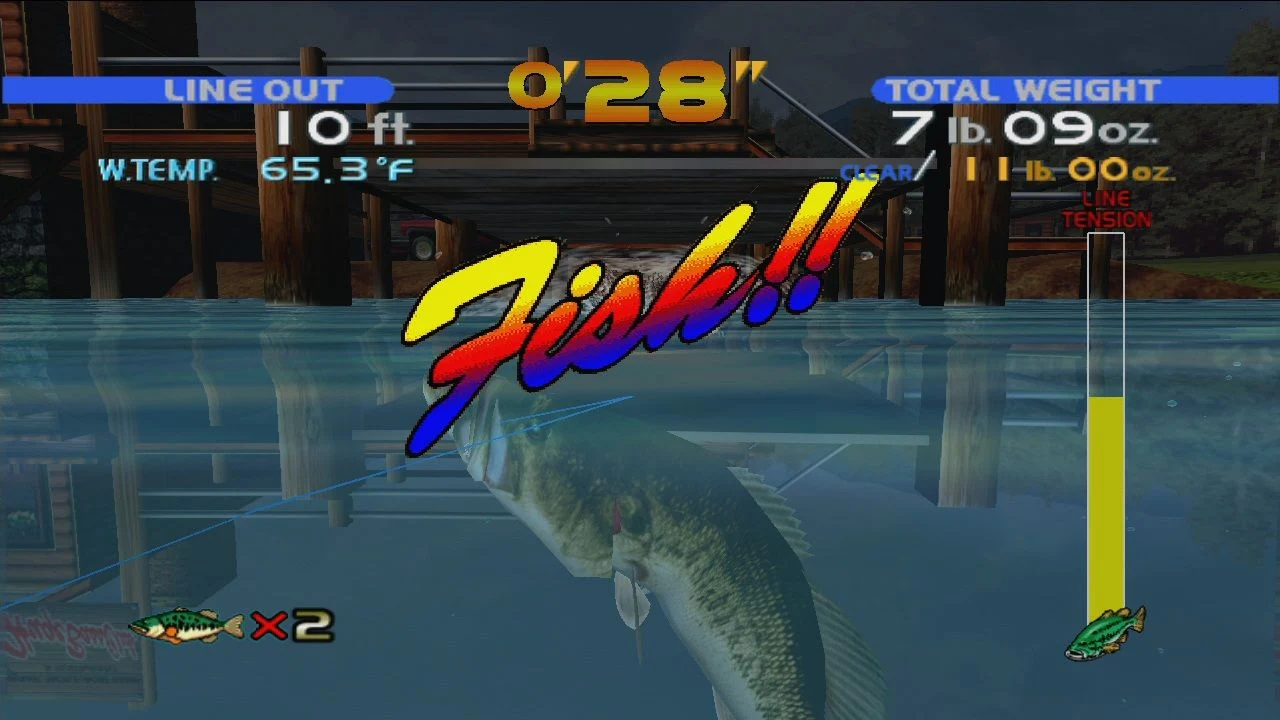
Read the arcade signal in its own loop
The SEGA Bass Fishing manual tells the player to watch the tension gauge during a fight and ease the reeling when tension becomes dangerous. The gauge works inside a fast sequence whose remaining time still matters. It gives a clear immediate problem: recover the fish without allowing the pressure to end the attempt badly.
Add equipment context in Fishing Planet
Fishing Planet’s fight sits inside a setup with separate component specifications and reel settings. The same-looking instruction to watch tension now connects to preparation as well as reaction. A problem may require understanding the selected outfit, not simply reproducing an input from another game. Keep the difference explicit instead of describing one system as an exact simulation of the other.
An illustrative overload decision
Imagine the gauge rises sharply in either game. The visible warning deserves attention, but a comparison article should not prescribe a shared button or numeric setting. In the arcade, explain the reeling and rod controls from the relevant edition. In Fishing Planet, explain the selected equipment and its controls separately. A useful comparison identifies the decision each game is asking you to make before judging whether one feels more demanding.
Do not transfer a muscle-memory shortcut blindly
A habit learned during short arcade runs may feel familiar enough to use automatically elsewhere. Pause to identify whether the new game separates retrieve speed, resistance and rod control in a different way. Conversely, carrying an elaborate simulator explanation into a compact arcade loop can hide the readable immediate feedback that makes the arcade enjoyable.
Build the diagram around the question
For SEGA, place tension beside time remaining and the immediate reeling action. For Fishing Planet, place tension beside the equipped components and control settings. The diagram should explain what surrounds the gauge, not invent a physics equation or a shared scale of difficulty that neither game supplies. A reader should be able to point to the warning, identify the relevant input and explain the surrounding objective. If the comparison does not provide those distinctions, a shared word such as tension adds little useful understanding.